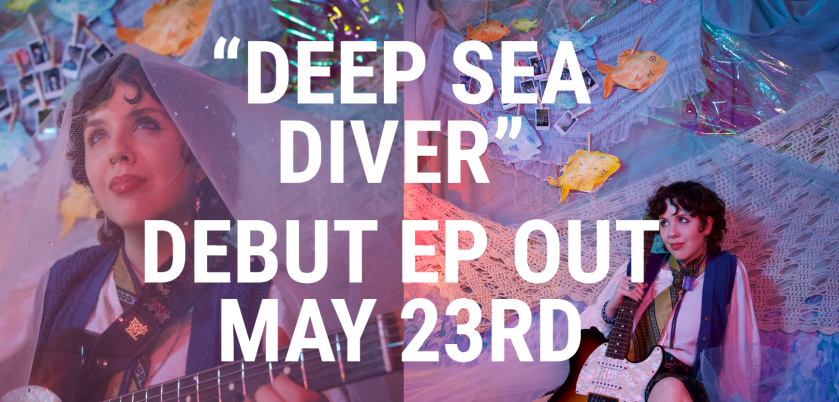
There’s an honesty in the storytelling nature of the songs from Oceanographer. There’s a dreamy gentle sway to the music. The music on the upcoming EP, Deep Sea Diver, will pull you in put the storytelling will keep you listening like you’re watching late night Netflix. You can hear it live May 23 at Can Can Wonderland – or check them out sooner at the events listed below.
Please tell us about your band, Oceanographer.
Oceanographer is what we call a “Midwest Dream Folk” band; it’s a happy mix of Laurel Canyon Folk, 90s Dream Pop, and Midwest Emo. I had been playing around Wisconsin under another name–Sir Valentine, and playing iterations of my songs that were way more folky singer-songwriter, but when I moved to the cities, I got a band together of some friends who helped bring some “edge” to the project. I was really happy that the songs became more genre expansive, and it made me feel a lot more free in my writing. We had a few changes in the band as people’s lives shifted–some of our members are focusing on their solo projects, some are going to law school, that kind of thing. But at the moment, our ensemble is myself (Val Lowry-Ortega) on songwriting, lead vocals, and rhythm guitar, Jim Deyoung on lead guitar, Nick Zuck on drums, and Jackson Peters on bass.
Your debut EP, Deep Sea Diver, gives such a nod to small town Minnesota. I love any music that highlights our area. I’m wondering how growing up in Worthington informs your music.
I think I wouldn’t be who I was if it wasn’t for Worthington. I was born and raised there, but for the longest time, I tried to run away from that truth. I transferred schools toward the end of high school and briefly went to Perpich Arts High in Golden Valley, and throughout college, I told everyone I was from “the Twin Cities.” I actually haven’t been back to Worthington since 2017. For some reason, I felt oddly embarrassed of being a rural kid; people have so many negative things to say about the rural midwest. But as I grew into myself a little more, I started to realize that a lot of my songwriting was really rooted in my nostalgia and homesickness for Worthington. Worthington is actually the most diverse city in the state per capita; my mom immigrated from Venezuela, and we ended up there, because it was such an immigrant-rich community. There are a lot of opportunities for work through JBS (the pork packing plant), and I grew up immersed in so many cultures: Karen, Laos, Central American, South American, Ethiopian. The first time I ever performed on a stage was actually at the Worthington International Festival, which is an annual celebration of the town’s diversity. Of course, there’s a healthy share of bigots in the town, too, so I grew up surrounded by a lot of cognitive dissonance. I experienced a lot of homophobia growing up, and I was universally hated during high school for being a politically-charged person, always bringing up discussions of social justice in the classroom. I think existing within those two universes was a really unique experience; I developed my sense of self really quickly.
I liked Moonlight until the line about having a boyfriend who doesn’t shower and then I loved it. The eye for detail and the subtle straightforward lyrics are disarming. The story you tell in a song could have lasted for at least a season in a television show. What is your writing process, lyrics first or melody? Are you methodical or writing on scraps of paper over the years?
I think my writing process for “Moonlight” definitely started with a very simple goal: wanting to include guitar bends in a song I wrote, because I had just learned how to do them. It’s ironic that such a simple goal turned into probably my most gut-wrenching song. I often start with melody and chords first, and almost think of it as painting an emotional soundscape. Once I have a chord progression to go off of, the lyrics come quickly. I think I wrote Moonlight in a single afternoon, sitting on the hardwood floor of the sunroom in my apartment here in Minneapolis. It’s probably one of the only songs I have that’s entirely true–I think of myself as a fiction writer, creating little hero characters to be the narrator of the story I’m trying to tell, but this one was stream-of-consciousness. Moonlight is about a homoerotic friendship I had in high school, and it was like my first queer “relationship” of sorts. We never actually “dated,” but we were constantly jealous of each other’s boyfriends, and it was a really confusing situation. We grew apart because our friendship became toxic, she wanted to stay in Worthington, and I wanted to pursue my music dreams in a big city. We didn’t talk for a year or two, and then she started reaching out to me on social media, telling me she was “never able to find a friendship as meaningful as ours.” She was dating some dude at the time, who was pretty greasy looking–I’m sure I was feeling a bit jealous. Around that time, she randomly snapchatted a picture of the dude holding an assault rifle, and it totally struck fear into my heart. I was worried about her safety, but she told me something to the avail of, “I used to be anti-gun, but ever since I’ve been with my man, I’ve changed my mind.” That’s where those lines in the song come from.
Please tell us about the inspiration for Midwest Cowboy. I love the name because I’ve always wondered if Midwest Cowboy was a thing – or do you have to be from Texas? As a city kid, I never wanted to ask but I think you’ve nailed the concept.
I think you can totally be a Midwestern Cowboy! I grew up with Dish Network, because my family was too poor for regular cable, and my mom was really into American country music, which I find hilarious, considering the fact she’s a South American Immigrant. She always had the CMT channel on, and so I grew up hearing a lot of post 9-11 Country, which can be really conservative in nature. I grew up around two different kinds of Midwestern Cowboys–the Mexican Vaqueros in my community, and the white conservative dudes. I think that dichotomy was really interesting, and as I got immersed in queer communities after moving away, I realized there was a third type of Midwestern Cowboy; the drag queen cowboy (like Chappell Roan). I think Midwestern Cowboy is my attempt at writing a parody country song, but it’s also very emotional, because it’s kind of based off of my experiences with compulsory heterosexuality. I didn’t come out as nonbinary until I was 22, and I was always in these “straight” relationships with these wayward Midwestern Cowboy types; gruff dudes who were pretty simple-minded, but still managed to break my heart. It took me a long time to figure out what my version of a queer relationship looked like, but now I have a nonbinary partner of 3 years, and we have a very happy relationship that’s pretty much free of gender-roles entirely.
Tell us about plans for the EP release and where folks might find you playing even before then.
Yes, we have lots of really fun stuff coming up! We have two shows as early as next week: April 1st at 331 Club and April 3rd at Underground Music Cafe. We are also playing a benefit show on April 25th at Soft Cult Studios to raise money for unhoused Indigenous Relatives in our community, heading over to Rochester Pride on May 17th, and then our EP release and release show is on May 23rd at Can Can Wonderland! That’s going to be our debut EP called “Deep Sea Diver”; three songs, and we are releasing a music video early on April 11th for Midwestern Cowboy to kind of gather some momentum. You can find the EP on all streaming platforms, but if you come to one of our shows, you can get it earlier than May 23rd by purchasing a CD from us! We really hope people enjoy “Deep Sea Diver,” and hope to see as many people at that release celebration as possible!
You can follow our instagram @Ocean0grapher, or visit our website at oceanographerband.com to sign up for our newsletter if you’re not on social media!
Photo credit: Hannah Marie Belisle
 Mostly Minnesota