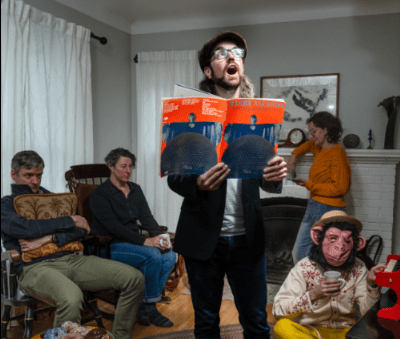
I love the idea of a tribute album with some liberties taken, so Ben Cook-Feltz‘s new album, Son of Schmilsson, originally produced by Harry Nilsson in 1972. It’s delightfully familiar and new at the same time. You can hear it live for yourself Sunday, August 10 at the Parkway Theater.
Why Son of Schmilsson? Why now?
That’s a darn good question! I’ve gotten this question a lot over the last few months, and the best answer I’ve come up with is… I have no idea. It seemed fun at the time!
I was looking for something to work on as I wrote new music. The idea of a song-for-song cover of an existing record felt like a fun challenge, and a little different from just covering various songs (which I already sort of did with the Christmas album). I’m also a huge Nilsson fan, which shouldn’t surprise anyone who’s heard my original stuff. I think he was a brilliant singer, songwriter and interpreter. As glorious as his own music is, he had an incredible ability to cover a song and make it his own. And, I have always been fascinated by this record.
There’s something beautifully inscrutable about Son of Schmilsson. It’s a very weird record, and deliberately so – Nilsson was cosmically talented and was coming off a string of incredible successes (a Grammy for “Everybody’s Talkin,” writing hit songs for the Monkees and Three Dog Night, and the back-to-back wonders of The Point! and Nilsson Schmilsson), and Son of Schmilsson is the point at which his streak of deliberate self-sabotage kicked into gear. He followed up his biggest chart success with an album full of burp takes, songs tailor-made for rock radio if they hadn’t been laced with unplayable lyrics, and goofy genre exercises full of puns and dad jokes. He just did what he wanted to do. But that’s what makes this record so fascinating to me – not only how uncompromising he was, but because underneath all of that lies a collection of really great, tuneful songs, full of the same wit and whimsy as his earlier material. Songs about the passage of time and the beauty of the world and living with dignity. It’s a nearly-brilliant gourmet meal packaged like a candy bar.
So it felt like there was a lot I could work with here. As soon as I thought about tackling this record, my synapses started firing and I found myself truly excited by the prospect. So that was a good sign. Plus, I figured if there was any time I could possibly sing a bunch of Harry Nilsson tunes, I should do it now before age really starts to take its toll. Everything about it made sense at this point in my life.
How do you bring 2025 sensibilities into songs that are more than 50 years old? It seems to me as if your version of Take 54 feels more authentically hurt and whereas Nilsson’s version seems to have a 1970s callousness about needing a woman (or at least a specific woman.) And your version of Joy feels more joyful whereas Nilsson’s version feels wistful. (To take just two examples.)
That’s a great question! It’s hard to tell for sure, but I think a lot of my choices were less informed by the changing times, as much as the difference between my sensibilities and Harry Nilsson’s sensibilities. As I mentioned before, Nilsson made this record at a point in his life I can’t really identify with. So the versions of the songs on Cook-Feltz Sings Son of Schmilsson are recorded by a well-adjusted guy in his mid-40s who is quite content with his life thank you, vs. everything Nilsson himself was going through (and his very declarative need for a woman at the time, which is pretty 70s for better or worse) and his track record for handling such things.
I will say, there were some lyrical challenges I encountered with this record, which tested my levels of comfort in ways they might not have if this were the early 70s. These are not songs I wrote. In particular, “I’d Rather Be Dead” is a song I’ve always struggled with. The lyrics are ostensibly about living and dying with dignity, which I definitely get behind, but the actual words themselves are juvenile humor at best, and legitimately offensive at worst. There were several people I reached out to, to contribute to the background vocals, who objected to taking part because of the lyrical content – they had friends or family who are infirm, or they just didn’t want to be on record singing this stuff. I considered a number of possibilities, including replacing the song with a Son of Schmilsson-adjacent tune, before deciding to just throw a bunch of bleeps over half of the words, and call it “I’d Rather BEEP Dead.” So now, the song doesn’t make any sense at all, and it sounds like we’re singing about stuff that’s way, way worse than the original lyrics ever were. (Especially since there are un-bleeped f-words at other points in the album.)
Spaceman has just an iconoclastic beginning, what made you bravely jump more directly into the song itself?
Ha! Is the term “bravely,” or “foolishly?” The choice to cut out the intro was in the context of my arrangement, and its placement on the album. To separate my version from the original, I wanted to start the first verse with a keyboard intro, and gradually build instrumentation until the second verse. To me, the only way the intro would have worked in that arrangement was to do something in free time, kind of like the Roches did on their “Spaceman” cover. However, that would mean things would be slowing down temporarily after the rousing bluegrass cover of “You’re Breakin My Heart.” This album already has a lot of shifts in pace and tempo, the first four songs are fast – slow – fast – slow, and I really wanted to just keep the train running for a bit. It just felt right to excise it.
That said! It was also the one part of the song I was happiest to not have to sing. Even though the words are sardonic (and iconoclastic as you mentioned), I am perfectly fine not having to sing “bang bang shoot ‘em up” in our current timeline. So it wasn’t a big loss.
We actually tried recording an intro to the song, with Doug Otto playing a super tasty bottleneck guitar part. I’ll be doing an approximation of that at the Parkway release show!
Please tell us about some of the folks who play with you on the album. It’s a great team.
It really is! The album features a lot of regulars in the BCF Cinematic Universe. I co-produced most of it with Peter Remiger, and there are contributions from Cole Mickelson, Andy Schuster, Doug Otto, Haley E Rydell and Daddy Squeeze Newton, all of whom have been on previous records (I’ve been working with Cole, Peter and Schuster for nearly 20 years now!). In addition, there are guest appearances from newer friends like Kai Brewster, John Bertsch, Anna Jennings, Ted Hajnasiewicz, Sumanth Gopinath and Beth Hartman from the Gated Community, even an appearance from Peter’s dad David on ukulele. Greg Reierson mastered it, and Emily Murphy did the artwork – both of whom are people I’ve gotten to work with on several occasions now. I’m a pretty socially awkward person, so my way of hanging out with people is asking them to play on my records. At this point, it’s pretty rewarding to say I’ve gotten to work with the same core of people for two decades, while continuing to get people I deeply admire to come along and play some truly ridiculous wonderful stuff. I feel really lucky.
The nature of this record also gave me a chance to branch out a little bit and work with a few outside producers and studios, and also recruit existing bands to serve as collaborators. The High 48’s play on “You’re Breakin My Heart,” which was a total thrill ride to record. “Spaceman” was tracked at Pearl Recording with Zachary Hollander, and Dave Mehling produced “Ambush.” Both of these experiences were a lot of fun, and I hope to get to work with them again in the future!
And tell us about the upcoming release show.
Oh, it’s gonna be a barn-burner! The show is dubbed A Little Night Of Nilsson In The Night. In addition to playing some of the songs from the new album, we’ll be covering a lot of other classic Nilsson tunes, like “Coconut,” “Without You,” “Me and My Arrow,” etc. There will be short sets from Dylan Hicks and the High 48’s, and guest appearances by Jillian Rae, Leslie Vincent, Brian Just, Doc and Mother Banjo, all taking a crack at leading tunes. Plus, we’ll see some of the faces from the album (Haley, Cole, Schuster, Anna, Dave, Sumanth and Beth), as well as Nikki Lemire, Eric Martin and Brent Fuqua. All gathered for one night only to pay tribute to one of rock’s most beloved court jesters. It’s going to be a blast!
 Mostly Minnesota