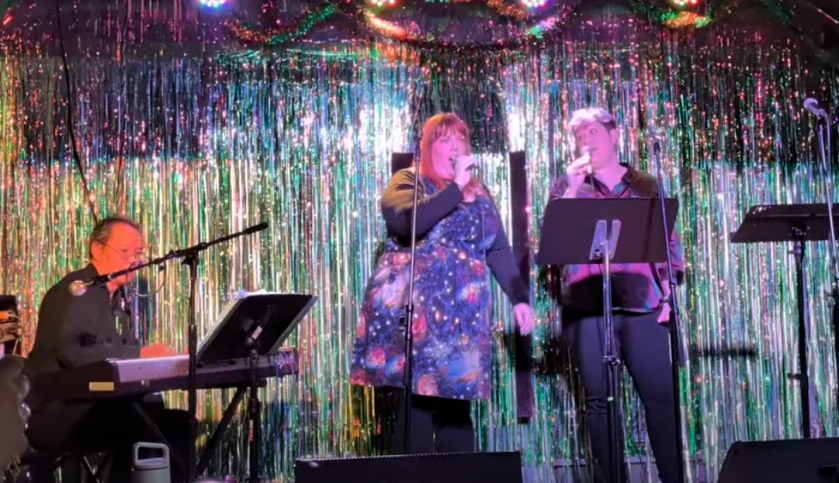
A couple weeks ago, I went to the White Squirrel to check out Musical Settings for Shakespeare. It was a unique and fun night. I got reminders of all the Shakespeare I’ve seen and read in the paste paired with music that was wry and charming. The performers bring the show to life. SO I was excited to learn more about them from founder, Ken Takata. You can also check them out at the Downtown St Paul Public Library on Jan 31.
Please tell me about yourself and how you got involved in music.
I’ve been playing music for a long time, but I haven’t been composing all that long. It’s really a lemons-and-lemonade story.
Specifically, in March 2020, all of my gigs shut down. So there I am wondering what musical project I could possibly work on. The obvious answer was to shift to composing since that’s something I could do in solitary confinement. I started cranking out melodies, mostly in the style of the Great American Songbook. What I found out is that I’m a relatively fast composer and an extremely slow lyricist, which makes a nice segue to the next section.
Please tell me about Musical Settings for Shakespeare.
Yes, well recall the bit about being a fast composer and slow lyricist? So there I am, searching around for a lyricist, particularly one that’s in the public domain, and what should turn up but Shakespeare? Plus, in addition, there’re always lots of productions of his plays since he’s the central figure in Western theatre arts. And, in addition, songs and music were integral parts of the original productions. There are over 70 texts that are designated as lyrics, but most of the music has been lost so it seemed like an opportunity to write some new settings in a variety of styles.
Fairly quickly I found that ideas and prompts came not only from specific texts but also what I call “staging problems” that a song might need to solve. By staging problem I mean some practical problem that a production might have to address. Here’s an example of one of the most central ones:
only 16% of Shakespeare’s text is delivered by female characters. However, if you consider the audience for Shakespeare, you’ll see that women constitute at least a majority.
In many cases, it’s much higher. There’s a disconnect between the demographics of the audience and of the characters onstage.
The question is how to address that. One way is to create a Shakespeare-related play in which one borrows lines, characters, or biographies. There are a lot of examples, particularly from the last decade. Hamnet, as a novel, play, and film, is probably the best known, but there are many others.
What happens, though, if you restrict the text purely to what is in the plays? My solution was to focus on text delivered by female characters and use musical techniques to focus the audience’s attention on that character and her perspective.
Seeing you at the White Squirrel I saw the passion in the performers and the joy. How did you all get together?
I’m glad it came across that way. It was a very loose show because we were trying to respond extemporaneously to the physical space and the audience. The White Squirrel Bar is a bar, after all, so we wanted to find music that would fit.
What I did prior to the show was create a set list organized by genre. Then I let the vocalists decide what they thought would work in that space and what they wanted to sing. Especially in that setting, it’s meant to be a collaboration, both on stage and also with the audience that happened to be there.
I try, whenever possible, to write for the skill sets and interests of specific performers. Both Laura Lentz Landstad and Sarah Callahan have experience in European folk musics. Sophie Caplin specializes in Baroque music and French art song. Sarah Zuber is partial to Kurt Weill and Irish folk music.
Getting to the second question, it’s probably more like a band than a theatre company. There aren’t formal auditions. You go to hear musical performances; you get info about who might be interested; you reach out and test a few tunes.
How do you choose the music?
There are musical styles that I want to write in. On top of that, there are staging problems that I want to solve that come from the plays and the way people have produced them. Then add to that what the musicians want to play. And then, you’ve got the performance space for a specific show. What we’d play at the White Squirrel Bar is totally different from what we’d play in other performance spaces. Each show really is different.
Please tell us about upcoming shows and opportunities to learn more.
Speaking of performance spaces, we have a big show coming at the George Latimer Central Library in downtown St. Paul. We’re going to be in the Magazine Room on the third floor on January 31st, 2026 from 2:00-3:30PM. It’s one of the great civic spaces in St. Paul, and it has a certain kind of formality to it. It’s also in the library, surrounded by publications and library materials so we’re putting together a set list that we think matches that space.
It’s musical settings of texts from literature with a lot of that coming from Shakespeare. Because it’s Jane Austen’s 250th anniversary, we have a couple of new settings of her texts. And there’s also settings using French poetry. Perhaps some Blake if we can fit it in.
Maybe I can say something about the Shakespeare settings. I talked earlier about staging problems. Here are a couple of staging problems that some of the settings are going to address:
- how do you depict a monarchy or central government, and the related question,
- is Shakespeare’s history play, Henry V, primarily about success or failure?
Usually productions emphasize the success (e.g., St. Crispin’s Day speech), but there’s a lot of it that is about failure. What makes this tricky is that different editions of the play contain different texts. You have the quarto edition from 1600 and then the Folio from 1623. The Folio has text that isn’t in the earlier edition and that talks much more about failure. It also refers to a contemporary event in 1599 about Elizabeth I sending the Earl of Essex to quell an uprising in Ireland. The reference isn’t in the first edition (1600), but it is in Folio (1623).
I suspect a lot of this has to do with Shakespeare’s theatre company trying to tip-toe around the censors, the government, and the monarchy. On one hand, they had to make sure that they didn’t get their heads cut off; on the other hand, anxiety about the arbitrary ways that the central government behaved was a major concern for the entire English population. Anything that could articulate that anxiety in an entertaining way had a good chance of being a hit on stage. Shakespeare had to figure out “safe” ways to articulate anger at the government or at a monarch since that sort of anger was crucial to attracting an audience in 1600, which was a very chaotic time.
Theatre, and to a certain extent religion, allowed people a forum to express that anger in a “safe space” where they could go back and claim that it’s simply what a character said. Stephen Greenblatt mentioned a bit of dialogue in The Winter’s Tale in which Paulina asks whether the heretic is not the person being burned at the stake but the executioner. That’s the sort of dangerous talk that if said in real life could have gotten you into a lot of trouble. England had blasphemy laws in place until the 1920s; Ireland until 2024.
Getting back to the library show, the good thing about the Magazine Room is that the space invites this sort of discussion and a performance that mixes up bits of the play with some history. Somehow, the musical setting is supposed to make it all hang together. The library show isn’t going to be a lecture, but we will perform a couple of settings that look at Henry V.
We’ll also have, for example, some settings from Two Gentlemen of Verona regarding one of the most problematic characters in all Shakespeare, Proteus.
I think the way I’d describe the library show is that it’s sort of like a cabaret/variety revue but without the spinning plates and with some short intros that delve into literature and history instead. There’ll be a bunch of different styles: the Great American Songbook, period correct (i.e., circa 1600), Western swing, glam rock, Scots-Irish folk music, parodies of radio ads from the 1940s, European art song, early 1950s R&B, 19th century parlor music, New Orleans piano ballads, odes to the Second Viennese School, bossa nova, Weimar cabaret, surf music, Bavarian yodeling, jug band songs, and several other genres, in other words, a little something for everyone.
For those that want to find out more, there’s a lot more at my website, https://kentakata.com . When possible, I try to offload much of the discussion to liner notes and essays that I put there. There’s specific info about the library show at: Ken Takata Ensemble: Musical Settings for Literature | Events | Saint Paul Public Library.
 Mostly Minnesota