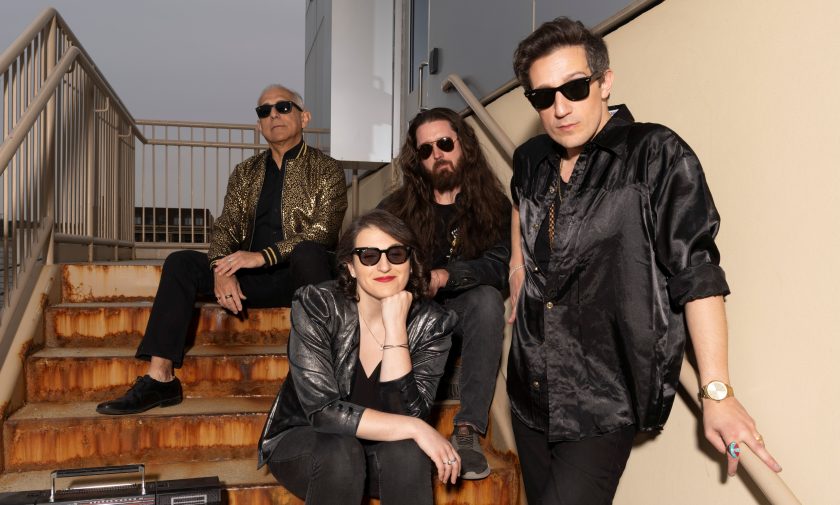
Silver Summer is celebrating a new album, Die of Love. It is an album of wild short stories with the most danceable soundtrack. And you can see them play it live tonight (June 20!) at The Ellerbe Room (inside of the Mankato Civic Center) at 6pm.
Please tell us about the band.
Colin: Silver Summer formed in the fall of 2019 when my wife and Good Night Gold Dust band mate Laura suggested that she and I start side projects to encourage a friend who had recently gotten back into music. Laura started an awesome all-girl band called Given Names; I started Silver Summer. The name came from a random line in Ghostbusters where Bill Murray says “Some are people who just want attention.” As a kid, I heard that line as “summer people” and it just got ingrained into my mind. I grew up in a small town about an hour south of Buffalo, New York, and moved to Mankato, MN in 2007 to get my MFA in Creative Writing. I’d been planning to go to NYC, but MSU’s program offered me a stipend and free tuition. In a way, Die of Love feels like my first novel.
Our bassist and drummer, Ed Avila and Tyler Vaughan, had been playing together in a super cool grunge-punk outfit called Goal Area 51. I recorded their first EP in 2018 (?) and knew they’d be a great fit for Silver Summer. Ed grew up in San Diego and during the mid- to late-’80s played bass in a goth / New Wave band in LA. He’s got an excellent musical ear and helps immensely with arrangements, instrumental melodies and countermelodies, and his bass lines are integral to the songs.
Tyler is a highly creative drummer who blends a Roland sample pad with his kit to enhance our sound. He helped engineer the album and also does a lot of production work for our live shows by setting up lights, PA, etc.
Hanna Cesario plays keys and also sings. She’d been giving piano, vocal, and ukulele lessons at the music shop where I worked, and one day I asked her if she’d ever consider playing the synth. She was like, “No, but I’ll learn.” She gave me vocal and piano lessons for a while, too, and helped me grow immensely as a musician.
Ed and Tyler are also educators at MSU, Mankato: Ed’s an English professor, and Tyler’s in sociology. But we know still know how to party!
Your upcoming Album, Die of Love, puts me right back to the dancefloor of First Ave for Danceteria night (or Camden Palace in London) in the 1980s. It’s like an album of wild short stories with the most danceable soundtrack. How intentional is the format and the call back to the era?
Colin: I’m so pleased to hear that! I love dancing, and I love creating music that makes people want to dance. Getting a crowd to dance is deceptively difficult, and when the dance floor gets hopping, it’s otherworldly. That said, some of the songs on Die of Love started out much differently. “Princess Bitch” and “White Boots”, for example,” began as piano ballads. I remember the morning I first plunked out the verse chords on our living room piano for what became “White Boots” and my wife Laura said something like, “Do they all have to be so sad?” So turned it into a disco song. But I was really taken by the early 00s Canadian indie disco thing. Bands like Wolf Parade, Arcade Fire, Feist, Hot Hot Heat—they all made you want to dance.
Incidentally, I didn’t get into New Order (or Prince!) until I moved from New York State to Minnesota for graduate school. I also love The Clash, and their wild synthesis of styles. Silver Summer’s developed the ability to move from rock to disco to reggae to atonal to anthemic, and that’s what I love about the band. We could probably a few more laid back tunes in the live set, though. Our shows tend to be wild, sweaty affairs, and both the band and the audience need a cardio break every few songs!
But I didn’t intend to make a dance album, or even a narrative-heavy album. The lyrical ideas just kept dragging me to the piano every night, and I’d stay up late exploring the lives of these wild and desperate people. As for the music, you get a little addicted to crowds dancing, and so I just kept writing music that would make me want to dance. Seems to be working so far!
What is the inspiration for the songs? Each song really is a story onto itself – the chase of “Catch Me”, the loss of “Breath”, the feeling of running away in “Silver Screen”. Did the songs create a theme or did you develop songs around the theme?
Colin: Some songs on Die of Love are distillations of adventures and their fallout from my trips to New York City in the early 2000s—and really my early 20s in general. I suppose I navigated those years like an observer, thinking that I’d write about it someday. I did everything I could to be as effortless as, like, Lou Reed or Julian Casablancas, but I was just nervous enough to keep a cool head when, like, heroin
showed up on the table at a party. I didn’t know how to process things like that until much, much later.
There are some loose diptychs and triptychs on the album, too: “Ocean Drive”, “Catch Me”, and “Silver Screen” might follow the same characters; “Closer” and “Princess Bitch” could star the same duo at different points in their timeline; “White Boots”, “Trouble”, and “Teeth” possibly shared drinks on the same dancefloor, and “Breath” and “Witness” embody a similar solemnity. I didn’t set out to write a rock opera. I didn’t even notice those connections until the mixing phase. But settings and imagery recur, and
there’s a little writing prompt of car references (a Firebird, a 1982 Chevy Malibu, a Delta 88, a Caprice, an unnamed convertible). The car stuff comes from listening to a lot of Bruce Springsteen as well as and Frank Ocean’s “White Ferrari”, which I couldn’t listen to for a long time because those opening synth pads would just destroy me. I was listening to Springsteen’s “Racing in the Streets” late one night became overwhelmed by this intense sadness. I wrote the phrase “crying over songs about cars” in my lyrics notebook, and that idea became another guide for Die of Love. Cars are generally pretty masculine objects, but they’re really just containers for vulnerability. Driving around with your new lover? Intoxicating! You could go anywhere, do anything, become anyone.
Combine that fresh-faced romanticism with real drugs and you get Die of Love. As for POV, many of the first-person characters are, in my mind, women, or women-identifying, or at least non-stereotypical straight men. I wrote most of the “you & me” relationships as same-sex relationships. Back to Springsteen, his songs about cars got me thinking back to high school and my friends who started drag racing on this dirt road on the outside of this one-horse town. I just felt so out of place. “Closer” came out of those memories. “Ocean Drive” has a lyric that goes “Nothing but pink skies / and Springsteen on the stereo”, so I guess he got in there pretty deep, haha. I don’t really remember where “Trouble” came from, but I do recall laughing pretty hard when I wrote the line “I’m in a bit of trouble / and trouble is in me”. It’s corny, kind of old-fashioned, but I immediately knew that woman and felt driven to tell her story.
The atmosphere of the album really began taking shape during Summer 2020. I’d started the band in the fall of 2019. We played three shows (Nov 2019, Jan & Feb 2020) and felt this incredible momentum—and then the pandemic hit. That lonely summer, a beat-up surf green Ford 500 started parking on the curb a few blocks up from our place. It became like the obelisk at the start of 2001: A Space Odyssey. I called it the Silver Summer car. I snapped Polaroids of it and one of those became our first t-shirt design.
I’d sometimes just stare at the car through the dining room window, sensing this incredible, radiating energy. So much was wrapped up in that hunk of metal: hope, joy, sadness, love, pain. One day on a walk I met the owner—a kid in his 20s—and his dad.
I started to explain all of this to them until I realized they thought I was nuts. A little while later I pulled up opposite the kid and his car at a gas station. He told me was going to sell the car. Sometime after that, the car appeared on a used lot. I made plans to check out the price, but then it was gone.
Another night around that era, I was up late working on music, because that’s just kind of what I did, and happened to look out the window as four teenager—two boys and two girls—rolled down Madison Avenue on skateboards. All of a sudden, they stopped and just laid down in the street, lit a joint, and blew smoke up to the stars. I would’ve felt similarly amazed if a unicorn flew past my house. It was pure magic, those kids and that brief moment of laying in the middle of the avenue smoking and laughing and clearly not giving a shit about anything. That feeling also guided Die of Love.
I also listened to Charli XCX’s Brat a lot while we were completing the album. I’ve always thought she was super rad, but never spent much time with her music until that album dropped. I made a couple references to Brat while mixing. I have this dream of Silver Summer opening for Charli, haha. Just putting that out there! Overall, Silver Summer has become a conduit for me to access and crystallize
experiences that might otherwise have just been absorbed into my, like, being. I’m grateful for whatever magic is at play that has granted me the opportunity to finally process those times.
The band is based in Mankato. Can you tell me about the music scene there and how being from Mankato shapes the band – if at all?
Colin: We’re a small, tightknit, supportive scene. Bands share members, every band has at least one highly qualified sound tech, we all have decent PA equipment that we share to help make sure our shows are high quality. Our venues are a couple bars—The Wine Café, the NaKato, the Oleander—and occasionally non-traditional venues like warehouse basements, rooftop wedding venues, backyards and open fields. The music is eclectic: lots of folk, lots of punk, hip hop, metal, experimental, jazz, indie.
A lot of groups rent rehearsal rooms in a warehouse on the edge of town, so we get to hear each rehearsing. I’ve also operated a recording studio for the past five or so years and really enjoy that process of helping bands make discoveries about their sound and ways to arrange music. Some of my songs are set at the venue where we play the most, so when I’m yammering on about dancefloors and neon lights, I’m mostly seeing The Wine Café. I suppose one way in which being from here has shaped us is having an off-site rehearsal space. In 2017, I tour managed an artist named Angelo de Augustine on his Minneapolis & Chicago dates. Angelo was the opening act for Moses.
Sumney, whose otherworldly sets propelled me to find a proper rehearsal room for my and my wife Laura’s band Good Night Gold Dust. The same can be said for other bands in town: our offsite studios allow for a lot of creative exploration.
Please tell us about your upcoming release show.
Colin: In 2022, I had the idea to stage a big formal concert on a rooftop. This became The Spring Formal, which evolved into The Summer Ball. They’re always themed events because, well, I love dressing up, and so does Mankato, it turns out! This year’s theme A SILVER SCREEN AFFAIR in honor of the heavy influence classic films had on the lyrics I wrote for Die of Love. Our original venue actually fell through about two
weeks ago, and luckily, we’re friends with the technical coordinator at the Civic Center, who finagled us The Bank Room—an old Art Deco bank that was absorbed by the Civic Center. It’s serendipitous in a way as the architecture goes well with the event’s theme. June 20 is also Summer Solstice eve. Charli XCX had Brat Summer; now we’ve got Silver Summer.

