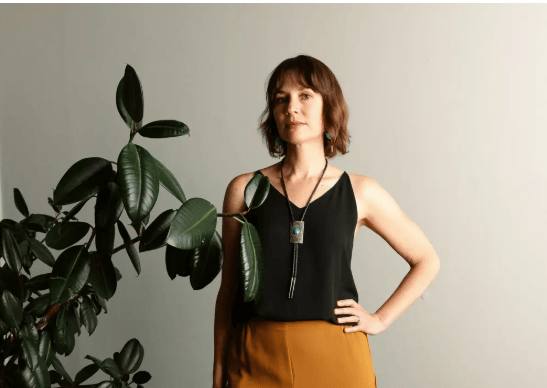
The first (and last) time I spoke “on record” with Jaspar Lepak was via zoom, during the pandemic. But our paths have crossed several times since as we both share a love of music (one playing, one listening), civic engagement and bodily autonomy. I even got to hear her sing The Ballad of the ERA at the Island of Discarded Women in 2023. Her music can sound soft and powerful in equal measures. It will draw you in. Her new album, We Are All Travelers Here, feels like a road trip and a lifetime met in the middle. So much to learn from both. You can hear it live at the Icehouse on Nov 13.
Your last album, So Strong, was overtly political (which I love); this new album, We Are All Travelers Here, feels like the personal side of politics or maybe more subtly political, especially with Storm in Their Eyes, but certainly not exclusively. Do you feel that connection? Or how do these albums connect (if at all) to you?
I do feel that connection. We Are All Travelers Here feels like a natural extension of So Strong. I actually went back and listened through So Strong after reading your question. While there are overtly political songs on that album, particularly around reproductive rights, most of the songs are deeply personal, too. Maybe because reproductive rights were being attacked so mercilessly when I was writing So Strong, those songs became such a prominent part of the album.
For this album, with so many injustices unfolding in the world, I found myself writing less about any one issue and more about how we respond to all that we’re witnessing. The songs on this album explore the injustice and collective grief in our world, while also asking: Who do I want to be right now? How do I want to show up? For myself, my family, and my community? I really believe that showing up with kindness and love is one of the most powerful ways we change the world.
There’s something so touching about the song, On the Inside. How does your music help you not live on the inside?
I’m so glad you are touched by “On the Inside!” Music is the one thing in my life that keeps asking me to be braver and braver. As a kid and young adult, people told me over and over again how shy I was, which only made me more insecure! Now that I’m older, I can see that I’m not necessarily shy; I’m an introvert. I need time and space to discover what I really want to say, and music gives me that space to dig in and find it.
When I first started performing, I would literally shake onstage and forget to breathe! I was so scared, but something about finally being able to say what I really thought and felt made me feel like I belonged. Music has been such a gift to me. The more I perform, the more comfortable I become in my daily life to speak up and live on the outside.
In Your Name is such an honest song about love, faith, human nature, and what our world (dare I say patriarchy) can do with such delicate ideals. Can you talk more about the line “God of love I still believe in you?” I’m not sure if I’m looking for an affirmation, persuasion or something else but it’s a song that makes me question things.
I spent my middle school, high school, and college years in the Evangelical church. I learned some powerful things about love in that community, but also some terrible messages about a woman’s place in the world. I left in my early twenties carrying a lot of hurt and anger, but the idea of universal love stayed with me.
I’ve considered myself agnostic, and I’ve even played with the word atheist, but I could never quite commit to either. After the 2024 election, I was heartbroken by the way the name of God was being used to elect leaders so full of hate. I couldn’t reconcile that with what I understood love to be.
As I wrestled with all of this while writing the song, I discovered something that surprised me: I do still believe in God. Not the Christian God I grew up with, but a God of Love—a universal love that connects us all, something we can feel when we tune into it. It’s the belief that we all belong to one another, that we share this planet, and that it’s our responsibility to take care of each other.
Traveling Home is a gorgeous, final song, made more final feeling by the fact that is it a solitary voice. Which came first, the song or the idea of an acapella song ending a song about traveling?
In 2022, my childhood friend died of stage 4 colon cancer. While she was still in treatment, I wrote “Queens of the Desert Sun” for her, which is on the album So Strong. It was my way of telling her how much I loved her and how deeply her friendship had shaped my life. She asked me to sing it at her memorial.
As I was preparing to travel to Bristol, England, for the service, I realized I wanted a secular hymn to sing at her graveside. She had requested an eco-burial in a beautiful city park and cemetery, and I couldn’t find anything that felt right. Then I remembered Hazel Dickens’s acapella rendition of the hymn “Beautiful Hills of Galilee” by T.B. Ausmus. I loved the chorus but wanted different verses, so I wrote new ones for my friend and played around with the melody. I sang it at her graveside.
It felt like the perfect song to end this album, especially because my friend was such a world traveler. We grew up together in Tucson, but she went on to live in Spain, China, Egypt, and England. I miss her so much. And it is my hope that she is still out there, traveling somewhere.
Please tell me about your upcoming release show.
I’m celebrating the release of We Are All Travelers Here with a special show at Icehouse in Minneapolis on Friday, November 13! I’ll be joined by the wonderful musicians who played on the album: Ben Cook-Feltz, Andy Schuster, DGS, and Haley E. Rydell, with special guest Peter Remiger. We’ll play songs from the new album, along with some older favorites.We’re planning two sets, with mini sets for my bandmates to step into the spotlight and share their own songs, too. It’s going to be a really special night of music and a chance to celebrate this album together. I’d love to see you there!

